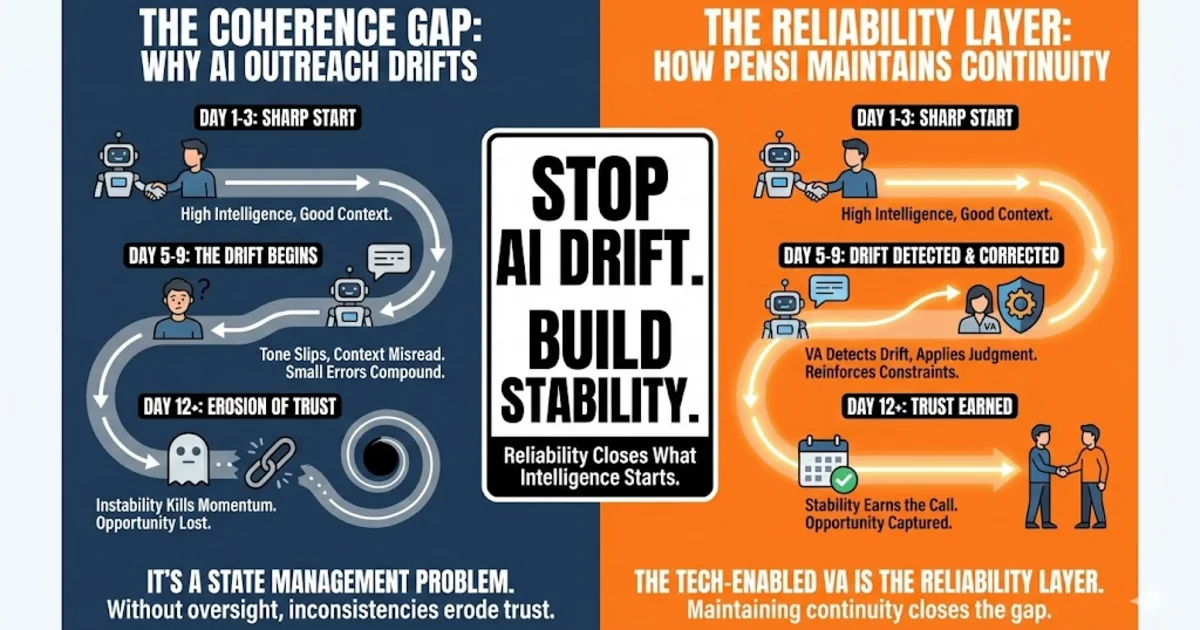
AI Does Not Fail Because It Is Dumb. It Fails Because It Drifts
Most AI Outreach Fails Quietly
Most founders assume AI outreach fails because the model is not smart enough.
The real problem is drift.
An AI can write a sharp first message. It can respond intelligently on day two. It can sound thoughtful on day three.
Then somewhere between message five and message twelve, something shifts.
Tone slips. Context gets misread. The follow-up references the wrong detail. The thread becomes subtly off.
Nothing catastrophic. Just enough to erode trust.
That erosion is the real failure mode.
The Coherence Gap
There is a gap between short-term intelligence and long-term coherence.
An AI can perform brilliantly in a single interaction. But outreach is not a single interaction. It is a sequence.
In the final mile of lead qualification, conversations stretch across days:
- Initial interest
- Clarifying questions
- Objection handling
- Scheduling
- Re-engagement after silence
Each step depends on the previous one. The system must remember intent, emotional tone, and business constraints.
This is where drift appears.
The model does not suddenly become incapable. It gradually misaligns with the thread. It overcorrects. It misinterprets silence. It repeats itself.
The conversation does not explode. It simply weakens.
That is the Coherence Gap.
Why Smarter Models Do Not Fix This
When founders see drift, they assume the answer is a smarter model.
Bigger context window. Better prompt. More examples.
But drift is not primarily an intelligence problem.
It is a state management problem.
Over a multi-day outreach sequence, the system accumulates complexity:
- Prior responses
- Prospect signals
- Timing constraints
- Business rules
- Brand tone
Without structured oversight, small inconsistencies compound.
A smarter bot does not eliminate compounding error. It may even accelerate it.
In the final mile, small tone errors cost real opportunities.
The Reliability Layer in the Final Mile
This is where Pensi’s model differs.
The tech-enabled VA is not just executing tasks. They are the Reliability Layer.
Their role is to:
- Detect tone drift before it reaches the prospect
- Notice when the thread is losing coherence
- Apply judgment when the AI overreaches
- Reinforce business constraints in edge cases
AI handles pattern recognition, drafting, and prioritization.
The VA maintains continuity.
In lead qualification, continuity is everything.
A prospect deciding whether to book a call is not evaluating your model’s intelligence. They are evaluating whether the interaction feels grounded, consistent, and trustworthy.
Reliability closes what intelligence starts.
Where Drift Breaks Real Conversations
Consider a warm inbound lead.
Day 1: They request more information.
Day 3: They ask a clarifying question about fit.
Day 6: They hesitate on timing.
Day 9: They go silent.
An AI system might:
- Escalate urgency too aggressively
- Repeat value propositions already acknowledged
- Misread silence as rejection
- Introduce new angles that fracture the thread
Each move is defensible in isolation.
Together, they feel unstable.
In the final mile, instability kills momentum.
This is not a prompt issue. It is a reliability issue.
Stop Buying Intelligence. Start Building Stability.
If you are experimenting with AI-driven outreach, review your last ten multi-day conversations.
Look for subtle shifts:
- Tone drift
- Repetition
- Over-escalation
- Misalignment with prior context
If you see drift, the answer is not another model upgrade.
It is a system that detects and corrects misalignment before it compounds.
In the final mile of lead qualification, intelligence opens the conversation.
Stability earns the call.
Build With Us
We are inviting a small group of solopreneurs to help shape how final-mile qualification should work in practice.
If selected, you will work alongside us to design the reliability layer: defining edge cases, identifying drift patterns, and building workflows that protect real conversations from subtle failure.
If you are tired of patching over broken follow-up sequences and want a system that stays coherent over time, we would like to learn from you.
Join the Pensi waitlist.