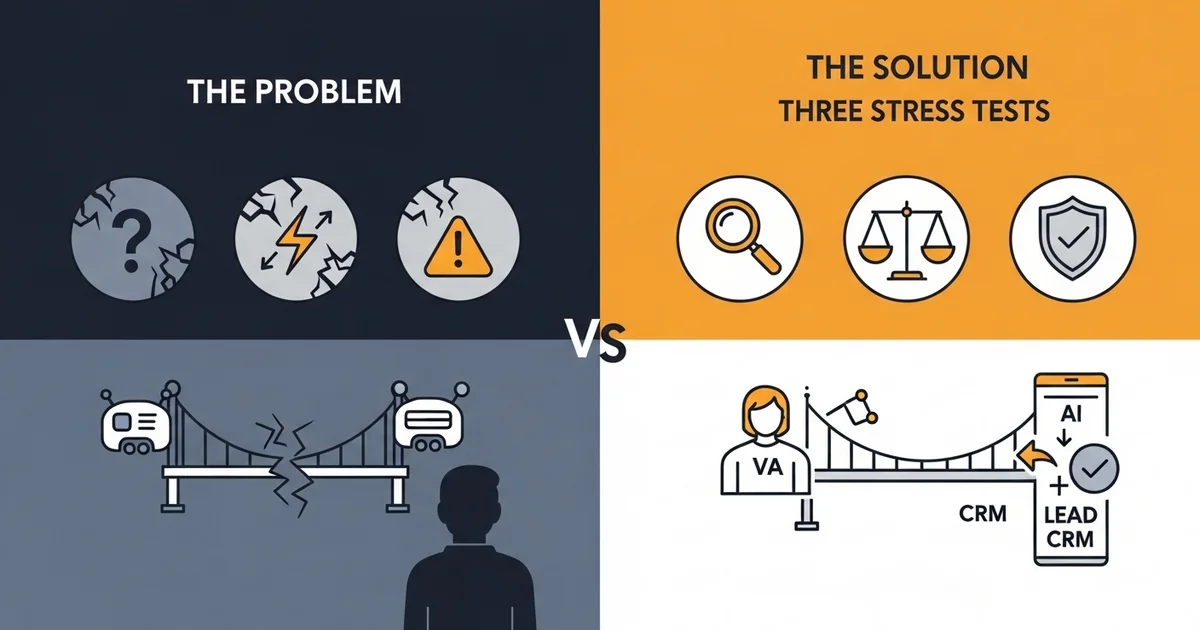
Three Stress Tests Every Solopreneur Should Run on Their Lead-Gen VA
When the AI Stumbles, the VA Steps In
Most solopreneurs trust AI with the first layer of lead qualification.
It tags the message. It drafts the reply. It updates the CRM.
Most of the time, it works.
But the failure does not look dramatic. It looks small. A subtle misread of intent. A priority misclassified. A response that sounds correct but feels slightly off.
This is the final mile of lead qualification. One misstep here can lose a high value prospect or weaken trust before you ever speak to them.
A tech-enabled VA supported by AI exists to catch these gaps. But reliability is not assumed. It is tested.
Here are three stress tests every solopreneur should run.
1. The Noncommittal Prospect Test
Scenario: A lead replies, “Not now, maybe Q4.”
This is not a no. It is not a yes. It is ambiguity.
Stress test your system.
Can your VA distinguish between a polite brush off and a real deferred opportunity?
Does the CRM get updated with the correct status and a follow up date tied to Q4?
Is escalation triggered if the deal size crosses a certain threshold?
Now examine the AI layer.
Does it summarize the response accurately, or does it inject optimism that is not there?
Document the exact handoff in a simple SOP. Define the tag. Define the follow up window. Define when you are pulled in.
You are not testing politeness. You are testing operational clarity at the final mile.
2. The Conflicting Signal Test
Scenario: A lead sounds eager on a call but becomes slow and vague over email. Their LinkedIn activity suggests they are exploring competitors.
Mixed signals are where automation drifts.
Run the stress test.
Can your VA reconcile these inputs before acting?
Do they pause outreach to clarify positioning, or do they push harder because the AI summary labeled the lead as “hot”?
Are AI generated summaries grounded in transcript reality, or are they smoothing over hesitation?
Define a chain of responsibility for conflict.
When signals diverge, who decides next action? The AI can aggregate data. The VA must interpret it. You retain final judgment.
This boundary reduces founder anxiety. You know exactly where human discretion begins.
3. The High Stakes Error Test
Scenario: The AI misclassifies a lead or sends a response that feels misaligned.
This will happen.
The question is not whether your system fails. The question is how it responds.
How quickly does your VA detect the issue?
Is there a daily review layer for high value leads?
What is the step by step protocol for correcting the message and restoring trust?
Test the timing. Measure the gap between error and intervention.
A reliable final mile is not error free. It is visible, documented, and correctable.
When errors are surfaced early and handled consistently, workflow stability increases. So does your confidence.
Why Deliberate Stress Testing Matters
Most SOPs look clean in theory.
They break in edge cases.
Without deliberate stress testing, you are assuming reliability instead of proving it. In the final mile, assumption is risk. A single mishandled conversation can cost revenue and reputation.
Stress testing forces your AI and VA to operate as a system.
AI handles speed and surface level pattern recognition. The VA applies judgment, context, and restraint. You define the thresholds.
This is how solopreneurs build operational stability in the final mile.
Not through more automation.
Through tested handoffs, clear boundaries, and documented recovery paths.
Build With Us
If you are relying on AI for lead qualification, do not stop at setup.
Run the tests. Document the edge cases. Tighten the handoffs.
A tech enabled VA supported by AI should make your pipeline more predictable, not more fragile.
That is the standard we build toward.